
Oneonta, AL Duct Services: Replace Ductwork in Walls & Attic
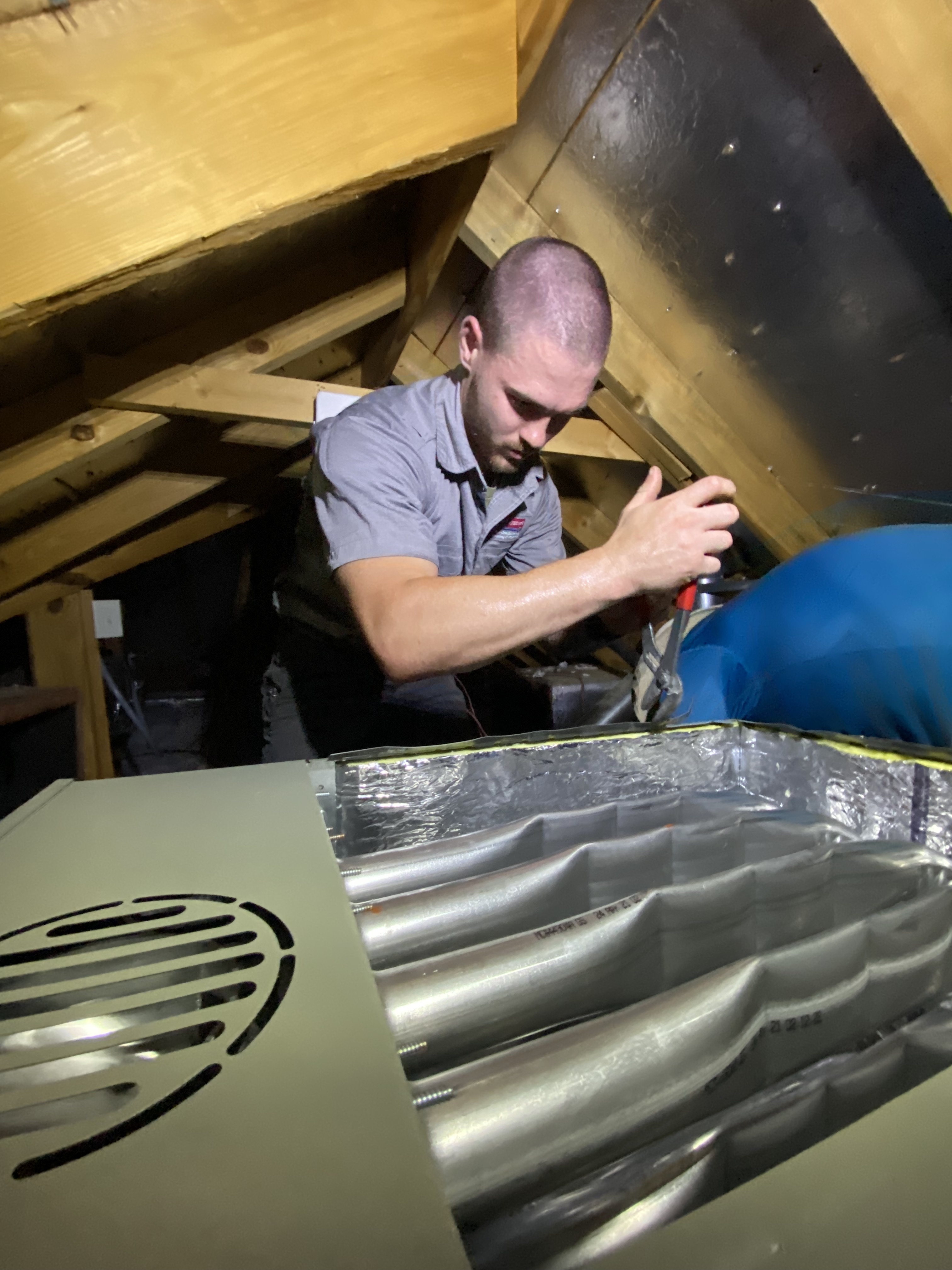
Replacing ductwork in existing walls and attic spaces can feel intimidating, but it is one of the highest-impact upgrades you can make. If you’re wondering how to replace ductwork without tearing your home apart, this guide walks you through safe, code-aware steps that protect comfort and efficiency. We’ll show you what to look for, how to plan, and the best methods for attic and wall runs. If you prefer a pro to handle it, our licensed team is ready to help and can also clean new ducts for peak airflow.
Why and When To Replace Ductwork
Leaky, crushed, or undersized ducts waste energy and starve rooms of airflow. In the Birmingham area, hot summers magnify losses from attic runs, while older wall ducts can hide gaps that pull in dust and insulation fibers.
Consider replacement if you notice:
- Comfort problems
- One or more rooms run hot or cold.
- Low airflow at the farthest supply registers.
- Visible damage
- Kinked or crushed flex in the attic.
- Rusted or disconnected sheet metal in wall chases.
- Air quality or odors
- Musty smells when the system starts.
- Excess dust even with regular filter changes.
- Age and efficiency
- Ducts older than 15 years, especially unsealed or uninsulated attic runs.
Replacing failing sections restores design airflow, improves indoor air quality, and can lower utility bills by reducing fan runtime.
Plan First: Codes, Sizing, and Safety
Safe, effective duct replacement starts with planning and compliance.
- Know your codes
- Follow the International Residential Code and local amendments. Fire blocking and firestopping rules apply to wall cavities used as chases. Penetrations must be sealed with approved materials.
- Validate sizing
- Correct sizing relies on Manual D calculations and the equipment’s airflow requirements. Replacing like for like can still be wrong if the original system was undersized or restricted.
- Static pressure and balancing
- Target total external static per manufacturer specs. Add balancing dampers to long branches and verify with a manometer.
- Licensing matters
- In Alabama, HVAC work must be performed by or under a contractor licensed by the Alabama Board of Heating, Air Conditioning, and Refrigeration. Choose NATE-certified techs for diagnostics and commissioning.
- Health and safety
- Use proper PPE. If you suspect asbestos on old duct insulation, stop and call a licensed abatement professional before any disturbance.
Hard facts you can trust: Wilbur’s has served the Birmingham area since 1979 and maintains BBB A+ accreditation. Our teams are NATE and EPA certified, and we commission every replacement to spec.
Tools and Materials You’ll Need
Having the right gear prevents leaks and callbacks.
- Duct types: Rigid galvanized, duct board, or UL 181 listed flex for branches
- Fittings: Wyes, elbows, reducers, starting collars with spin-in dampers
- Sealants: Water-based mastic and UL 181 tape for pressure-sensitive seams
- Fasteners: Zip screws, draw bands, hanger strap
- Insulation: R-8 for unconditioned attics per local energy code
- Test instruments: Manometer, anemometer, smoke pencil
- Safety: Eye protection, gloves, knee protection, attic planks, respirator
How To Replace Ductwork in Attic Spaces
Attics in Central Alabama can exceed 120°F in summer, so insulation and air sealing are critical.
- Inspect and map existing runs
- Photograph connections. Note trunk size, branch sizes, and register locations. Mark problem runs that are crushed, too long, or have sharp turns.
- Remove failing sections
- Isolate the HVAC power. Detach flex or metal runs from collars. Cap open trunks while you work to keep dust out.
- Correct routing
- Shorten travel and reduce turns to cut friction. Replace tight 90-degree turns with two 45-degree fittings where possible.
- Size it right
- Match branches to design CFM. Increase trunk size if static pressure is high. Add return capacity to reduce noise and improve comfort.
- Connect and seal
- Seat flex inner core fully over the collar, strap it tight, apply mastic, then pull insulation over the joint. For metal, screw, tape with UL 181, then mastic every seam.
- Support and insulate
- Support flex every 4 feet with 1.5 inch wide strap. Avoid sag greater than 1 inch per 4 feet. Use R-8 insulation for all ducts in unconditioned spaces.
- Test and balance
- Power on. Check static pressure, supply CFM at key registers, and set dampers to balance rooms. Listen for whistling that indicates leaks.
Pro tip: Replace long attic branches with a short branch and a properly located new register when rooms are persistently under-conditioned. This often costs less than upsizing equipment and gives better results.
How To Replace Ductwork in Existing Walls
Wall replacements require careful planning because cavities can hide fire blocks, wires, and plumbing.
- Locate the chase
- Use a stud finder and inspection camera to trace the path from basement or crawlspace to the register. Look for blocking at each floor line.
- Open strategically
- Cut small access points at horizontal blocks and at the top and bottom of the chase. Protect floors and furniture. Keep cuts tight to ease patching.
- Choose materials
- For straight, smooth runs, rigid metal with sealed joints is ideal. For tight passes with offsets, UL 181 listed flex can be used for short sections. Do not use wall cavities as plenums.
- Fire blocking and sealing
- After installing new duct, restore fire blocking with approved materials. Seal all penetrations with fire-rated sealant where required.
- Connect to registers and trunks
- At the register boot, ensure a snug, sealed connection. At the basement or attic trunk, use a starting collar with a damper for balancing.
- Sound control
- Line metal boots where possible and avoid direct framing contact to cut vibration. Properly sealed ducts are quieter and cleaner.
- Commission the run
- Verify supply CFM and temperature split. Adjust damper to match adjacent rooms.
Avoid common pitfalls:
- Unsealed joints that pull air from wall cavities
- Long flex sections that reduce CFM
- Missing fire blocking at floor lines
- Boots that are loose in drywall, causing leakage and dust rings
Sealing, Insulating, and Air Balancing
A new duct is only as good as its sealing and insulation.
- Seal every joint with mastic. Tape alone is not enough over time.
- Insulate to R-8 in unconditioned attics to prevent heat gain and sweating.
- Pressure test if possible. Even spot tests with a manometer can reveal problem areas.
- Balance for comfort. Start with dampers half open, then measure and fine-tune. Bedrooms and bonus rooms at the end of long runs may need slightly more flow.
Cost, Timeline, and What to Expect in Birmingham Homes
Every home is different, but a clear plan keeps costs predictable.
- Scope factors
- Access: Attic headroom in Vestavia Hills ranch homes is usually easy. Tight knee walls in Hoover bonus rooms add time.
- Material: Rigid metal and lined boots cost more but deliver better airflow and durability than long flex runs.
- Length and fittings: Each elbow and foot of duct adds resistance. Fewer turns and shorter runs reduce both cost and operating expense.
- Repairs: Drywall patching at wall access points and adding returns or new registers increase project totals.
- Typical timelines
- Single branch replacement: 2 to 4 hours
- Full attic branch set on a single zone: 1 day
- Multi-floor wall chase plus attic trunk changes: 1 to 2 days
- Value adds
- Post-replacement cleaning clears construction dust and boosts air quality. This pairs well with our duct cleaning offer.
Local insight: In summer humidity, uninsulated metal in attics can sweat and stain ceilings. Correct insulation and vapor barriers prevent moisture problems and extend ceiling life.
DIY vs Pro: When To Call a Licensed HVAC Contractor
Some homeowners can replace a short attic run with proper guidance. Call a pro when you face any of the following:
- You need Manual D sizing or static pressure diagnostics.
- You are replacing ducts inside walls or near fire-rated assemblies.
- You see signs of mold, asbestos, or damaged insulation.
- Rooms remain uncomfortable after previous attempts.
Why Wilbur’s is a safe choice:
- In business since 1979 with a BBB A+ rating
- NATE and EPA-certified technicians who commission every job
- 100% Satisfaction Guarantee, warranties on every service, and upfront pricing
- Licensed by the Alabama Board of Heating, Air Conditioning, and Refrigeration
- Flexible scheduling across Birmingham, Tuscaloosa, Hoover, Vestavia Hills, Alabaster, and more
Post-Replacement Care: Keep Airflow Strong
New ducts stay cleaner and more efficient with simple care.
- Replace filters on schedule. High-MERV filters trap fine dust but must be changed more often.
- Book professional cleaning when needed. Pet hair, renovations, or allergy concerns can justify more frequent service.
- Join The Pink Plan for proactive maintenance. The plan includes two system inspections per year, with a duct inspection noted in the checklist. It helps extend equipment life, reduce breakdowns, and keep utility bills lower.
Our cleaning process is thorough: pre-inspection and assessment, removal of vent covers and access points, agitation and extraction of contaminants, sanitization and deodorization, and a post-cleaning walkthrough. Pairing this with new ductwork keeps your system performing like new.
Special Offer for Birmingham-Area Homeowners
Special Offer: Save $199 on duct cleaning. Use it to clear construction dust after your duct replacement and improve airflow. Offer expires 12/31/2026. Not valid with other offers. Present coupon at time of service.
Call (205) 675-0280 or schedule at https://www.callwilbur.com/ and mention the $199 Off Duct Cleaning promotion.
What Homeowners Are Saying
"The techs, Edgar and Andrew, were polite and professional. They did a great job with our duct cleaning and explained everything in detail. Additionally, before and after photos were provided, which was nice. I will definitely recommend Wilbur to others!"
–Connie W., Duct Cleaning
"I called these guys out for an estimate on some ductwork repairs. I was very impressed at their honesty, professionalism, promptness and the way that my concerns were handled with these guys Jake, Jordan and John were amazing. They were very knowledgeable, and did not try to charge me for things that I didn't need. I look forward to doing business with them. I highly recommend them ! 10/ 10."
–Dabney D., Ductwork Repairs
Frequently Asked Questions
How do I know if my ducts in the walls really need replacement and not just sealing?
If rooms are uneven, ducts are older than 15 years, and you see rust, crushed runs, or persistent dust streaks at registers, inspect with a camera. A pro can pressure test to confirm.
Is flex duct OK inside walls?
Use short, UL 181 listed flex only when necessary for offsets. Rigid metal with sealed seams is preferred for straight vertical wall chases. Never use the wall cavity as a plenum.
What insulation do I need for attic ducts in Alabama?
Use R-8 insulation on supply and return runs in unconditioned attics. Seal all joints with mastic before insulating to prevent sweating and energy loss.
How long does duct replacement take?
A single attic branch often takes 2 to 4 hours. Multi-branch attic work can take a day. Wall replacements with blocking and patching may take 1 to 2 days.
Should I clean ducts after replacement?
Yes. Replacement stirs dust and debris. A professional cleaning and sanitization restores air quality and protects your coils and blower from buildup.
In Summary
Replacing ductwork in existing walls and attic spaces improves comfort, air quality, and long-term efficiency when planned and executed correctly. Use proper sizing, sealing with mastic, R-8 insulation, and final balancing. For Birmingham homes, this upgrade pays off fast during peak summer heat.
If you want a licensed team to design, replace, and commission your ducts right the first time, we are ready to help.
Ready to Upgrade Your Ducts?
Call Wilbur’s at (205) 675-0280 or book online at https://www.callwilbur.com/ for expert duct replacement and post-project cleaning. Ask for the $199 Off Duct Cleaning special before 12/31/2026. Serving Birmingham, Hoover, Vestavia Hills, Tuscaloosa, Alabaster, and nearby neighborhoods.
About Wilbur's Air Conditioning, Heating & Plumbing
We’re Birmingham’s trusted HVAC and plumbing team, proudly family owned since 1979. Our NATE-certified, EPA-certified technicians deliver upfront pricing, strong warranties, and a 100% Satisfaction Guarantee. We’re BBB A+ accredited and licensed by the Alabama Board of Heating, Air Conditioning, and Refrigeration. From duct diagnostics to cleaning and full replacements, we bring 24/7 responsiveness, meticulous workmanship, and local know-how across Birmingham, Hoover, Vestavia Hills, and beyond.
Sources12
Source links open in a new tab.
- $199 Off Duct Cleaningcallwilbur.com (opens in a new tab)
- 10% off your first service at Wilbur's Air Conditioning, Heating & Plumbing. Print offer or call to redeem.wilbur1.com (opens in a new tab)
- 10% Off Your 1st Service — discount applies to first service booked with Wilbur's.wilbur1.com (opens in a new tab)
- Free no-obligation estimate on a water softener system installed by Wilbur’swilbur1.com (opens in a new tab)
- Happy comment by Paul Elmoregoogle.com (opens in a new tab)
- Happy comment by Josh Wootengoogle.com (opens in a new tab)
- Happy comment by Key Keygoogle.com (opens in a new tab)
- Happy comment by Connie Wallgoogle.com (opens in a new tab)
- AC Duct Repair & installation in Birmingham, AL | Home HVACwilbur1.com (opens in a new tab)
- Packaged Unit Repair & Maintenance in Birmingham, ALwilbur1.com (opens in a new tab)
- Sewer Drain Cleaning Birmingham, AL - Exceptional Drain & Sewer Serviceswilbur1.com (opens in a new tab)
- Heat Pump Services in Birmingham, ALwilbur1.com (opens in a new tab)